Our Easter Event was a huge success, the children enjoyed themselves and saw that they could have as kite flying fun as anybody else, sighted or not.
They were able to feel a great sense of accomplishment and joy as they made their kites and were aided in having them lifted into the air.
Not forgetting the reason behind the season as we put it hear in Grenada.
Lunch was delicious and fun was abundant, what more could one ask for.
Here, take a look:
Special thanks goes out to Anjuli and Justin for being our Easter Egg sponsors from the staff and students of the Resource Centre for the blind :D
Tuesday, April 27, 2010

Wednesday, March 10, 2010
The Snellen Chart (Part 3 of 3 )
Snellen, inventor of said chart, defined “standard vision” as the ability to recognize one of his optotypes when it subtended 5 minutes of arc. Thus the optotype can only be recognized if the person viewing it can discriminate a spatial pattern separated by a visual angle of 1 minute of arc.
In the most familiar acuity test, a Snellen chart is placed at a standard distance, twenty feet in countries where that is the customary unit of measure. At this distance, the symbols on the line representing "normal" acuity subtend an angle of five minutes of arc, and the thickness of the lines and of the spaces between the lines subtends one minute of arc. This line, designated 20/20, is the smallest line that a person with normal acuity can read at a distance of twenty feet.
Three lines above, the letters have twice the dimensions of those on the 20/20 line. The chart is at a distance of twenty feet, but a person with normal acuity could be expected to read these letters at a distance of forty feet. This line is designated by the ratio 20/40. If this is the smallest line a person can read, the person's acuity is "20/40," meaning, in a very rough kind of way, that this person needs to approach to a distance of twenty feet to read letters that a person with normal acuity could read at forty feet. In an even rougher way, this person could be said to have "half" the normal acuity.
In countries using the metric system, the standard chart distance is six meters, normal acuity is designated 6/6, and other acuities are expressed as ratios with a numerator of 6.
Acuity charts are used during many kinds of vision examinations, such as "refracting" the eye to determine the best eyeglass prescription. During such examinations, acuity ratios are never mentioned.
The biggest letter on an eye chart often represents an acuity of 20/200, the value that is considered "legally blind." Many people with refractive errors have the misconception that they have "bad vision" because they "can't even read the E at the top of the chart without my glasses." But in most situations where acuity ratios are mentioned, they refer to best corrected acuity. Many people with moderate myopia "cannot read the E" without glasses, but have no problem reading the 20/20 line or 20/15 line with glasses. A legally blind person is one who cannot read the E even with the best possible glasses.
In the most familiar acuity test, a Snellen chart is placed at a standard distance, twenty feet in countries where that is the customary unit of measure. At this distance, the symbols on the line representing "normal" acuity subtend an angle of five minutes of arc, and the thickness of the lines and of the spaces between the lines subtends one minute of arc. This line, designated 20/20, is the smallest line that a person with normal acuity can read at a distance of twenty feet.
Three lines above, the letters have twice the dimensions of those on the 20/20 line. The chart is at a distance of twenty feet, but a person with normal acuity could be expected to read these letters at a distance of forty feet. This line is designated by the ratio 20/40. If this is the smallest line a person can read, the person's acuity is "20/40," meaning, in a very rough kind of way, that this person needs to approach to a distance of twenty feet to read letters that a person with normal acuity could read at forty feet. In an even rougher way, this person could be said to have "half" the normal acuity.
In countries using the metric system, the standard chart distance is six meters, normal acuity is designated 6/6, and other acuities are expressed as ratios with a numerator of 6.
Acuity charts are used during many kinds of vision examinations, such as "refracting" the eye to determine the best eyeglass prescription. During such examinations, acuity ratios are never mentioned.
The biggest letter on an eye chart often represents an acuity of 20/200, the value that is considered "legally blind." Many people with refractive errors have the misconception that they have "bad vision" because they "can't even read the E at the top of the chart without my glasses." But in most situations where acuity ratios are mentioned, they refer to best corrected acuity. Many people with moderate myopia "cannot read the E" without glasses, but have no problem reading the 20/20 line or 20/15 line with glasses. A legally blind person is one who cannot read the E even with the best possible glasses.
Tuesday, March 9, 2010
An Easter of Equality
An Easter of Equality
The Resource Centre for the blind is making preparations to carry out this theme as they plan their Kite making and kite fly Easter Event.
Said event is scheduled for the 17th of March 2010 where the blind and visually impaired students of Grenada will assemble together with the necessary material at the Mt. Erie playing field, St. David between the hours of 9am-3pm.
Under the supervision of their teachers they will put together their very own kites
After which students will provided with lunch and a short presentation. Reminding them, of the reason behind Grenada’s Easter celebrations.
To end the day the students as well as their teachers will proceed to the adjoining pasture where teachers and students, blind and sighted will fly their self made kites together displaying by example that disability truly is NOT inability.
The Resource Centre for the blind is making preparations to carry out this theme as they plan their Kite making and kite fly Easter Event.
Said event is scheduled for the 17th of March 2010 where the blind and visually impaired students of Grenada will assemble together with the necessary material at the Mt. Erie playing field, St. David between the hours of 9am-3pm.
Under the supervision of their teachers they will put together their very own kites
After which students will provided with lunch and a short presentation. Reminding them, of the reason behind Grenada’s Easter celebrations.
To end the day the students as well as their teachers will proceed to the adjoining pasture where teachers and students, blind and sighted will fly their self made kites together displaying by example that disability truly is NOT inability.
Tuesday, February 23, 2010
The Snellen Chart (Part 2 of 3 )
How to use a Snellen Chart
Visual acuity is typically measured monocularly rather than binocularly with the aid of an optotype chart for distant vision, an optotype chart for near vision, and an occluder to cover the eye not being tested. The examiner may also occlude an eye by sliding a tissue behind the patient's eyeglasses, or instructing the patient to use his or her hand. This latter method is typically avoided in professional settings as it may inadvertently allow the patient to peek through his or her fingers, or press the eye and alter the measurement when that eye is evaluated.
1. Place the chart at 20 feet (or 6 meters) and illuminate to 480 lux at that distance.
2. If the patient uses glasses, then the test is performed using them.
3. Place the occluder in front of the eye that is not being evaluated. The first evaluated eye is the one that is believed to see less or the one the patient says that is seeing less.
4. Start first with the big optotypes and proceed to the smaller ones. The patient has to identify every one on the line being presented and communicate it to the physician.
5. If the measurement is reduced (below 20/20) then the test using a pinhole should be done and register the visual acuity using the pinhole. Both measures should be registered, with and without using pinhole.
6. Change the occluder to the other eye and proceed again from the 4th step.
7. After both eyes have been evaluated in distant visual acuity, proceed to evaluate near visual acuity placing a modified snellen chart for near vision (such as the Rosembaum chart) at 14 inches (or 35 centimeters). Then repeat the test from the 2nd step.
In some cases, binocular visual acuity will be measured, because usually binocular visual acuity is slightly better than monocular visual acuity.
Infant vision
The newborn’s visual acuity is approximately 20/400 and 20/20 by age 2 years. [8]
Terms Associated with the Snellen Chart
O.D Ocular dexter (right eye)
O.S Ocular sinster (left eye)
O.U. Oculi unitas (both eye)
Prism diopter
+ Plus or convex lens
C.F. Count fingers
H.M. Hand movement
L.P. Light perception
N.L.P No light perception
Criticism
Snellen charts have been the target of some criticism. The fact that the number of letters increases while the size decreases introduces two variables, rather than just one. Some people may simply memorize the Snellen chart before being tested by it, to give the impression that their vision is good. Several studies indicate that the crowding together of letters makes them inherently more difficult to read. Another issue is that there are fairly large and uneven jumps in acuity level between the rows. To address these concerns, more modern charts have been designed that have the same number of letters on each row and use a geometric progression to determine the size of each row of letters.
Visual acuity is typically measured monocularly rather than binocularly with the aid of an optotype chart for distant vision, an optotype chart for near vision, and an occluder to cover the eye not being tested. The examiner may also occlude an eye by sliding a tissue behind the patient's eyeglasses, or instructing the patient to use his or her hand. This latter method is typically avoided in professional settings as it may inadvertently allow the patient to peek through his or her fingers, or press the eye and alter the measurement when that eye is evaluated.
1. Place the chart at 20 feet (or 6 meters) and illuminate to 480 lux at that distance.
2. If the patient uses glasses, then the test is performed using them.
3. Place the occluder in front of the eye that is not being evaluated. The first evaluated eye is the one that is believed to see less or the one the patient says that is seeing less.
4. Start first with the big optotypes and proceed to the smaller ones. The patient has to identify every one on the line being presented and communicate it to the physician.
5. If the measurement is reduced (below 20/20) then the test using a pinhole should be done and register the visual acuity using the pinhole. Both measures should be registered, with and without using pinhole.
6. Change the occluder to the other eye and proceed again from the 4th step.
7. After both eyes have been evaluated in distant visual acuity, proceed to evaluate near visual acuity placing a modified snellen chart for near vision (such as the Rosembaum chart) at 14 inches (or 35 centimeters). Then repeat the test from the 2nd step.
In some cases, binocular visual acuity will be measured, because usually binocular visual acuity is slightly better than monocular visual acuity.
Infant vision
The newborn’s visual acuity is approximately 20/400 and 20/20 by age 2 years. [8]
Terms Associated with the Snellen Chart
O.D Ocular dexter (right eye)
O.S Ocular sinster (left eye)
O.U. Oculi unitas (both eye)
Prism diopter
+ Plus or convex lens
C.F. Count fingers
H.M. Hand movement
L.P. Light perception
N.L.P No light perception
Criticism
Snellen charts have been the target of some criticism. The fact that the number of letters increases while the size decreases introduces two variables, rather than just one. Some people may simply memorize the Snellen chart before being tested by it, to give the impression that their vision is good. Several studies indicate that the crowding together of letters makes them inherently more difficult to read. Another issue is that there are fairly large and uneven jumps in acuity level between the rows. To address these concerns, more modern charts have been designed that have the same number of letters on each row and use a geometric progression to determine the size of each row of letters.
Wednesday, January 27, 2010
The Snellen Chart part (1 of 3)
One might ask himself, how is it the Resorce Centre for the Blind identifies students who need low vision aid or Braille study?
Every new school year (beginning in September) the Resource Centre for the Blind in collaboration with nurses attached to the Ministry of Health sets out into the primary schools of Grenada Cariacou and Petite Martinique to ‘Vision Screen’ students of the Grade six, the class where students are being prepared to sit the Secondary School ‘Common Entrance’ exams, as well as the first grade students that have just entered the school system as previous studies have shown that eye diseases and concerns tend to develop mainly during this age range (3-4 and 11-12)
This is an observational exam that results only in our recommendation that students see a licensed optermologist who can then give a professional opinion as to the student’s visual state and what their visual acuity really is. After this is done, the Resource Centre for the Blind then provides services such as large print photo copies, Braille lessons and teacher guidance as is required.
The main tool used during our observational study is: The Snellen Chart.
Description
The traditional Snellen chart is printed with eleven lines of block letters. The first line consists of one very large letter, which may be one of several letters, for example E, H, N, or A. Subsequent rows have increasing numbers of letters that decrease in size. A patient taking the test covers one eye, and reads aloud the letters of each row, beginning at the top. The smallest row that can be read accurately indicates the patient's visual acuity in that eye.
The symbols on an acuity chart are formally known as "optotypes." In the case of the traditional Snellen chart, the optotypes have the appearance of block letters, and are intended to be seen and read as letters. They are not, however, letters from any ordinary typographer's font. They have a particular, simple geometry in which:
• the thickness of the lines equals the thickness of the white spaces between lines and the thickness of the gap in the letter "C"
• the height and width of the optotype (letter) is five times the thickness of the line.
Only the nine letters C, D, E, F, L, O, P, T, Z are used in the traditional Snellen chart.
Wall-mounted Snellen charts are inexpensive and are sometimes used for rough assessment of vision, e.g. in a primary-care physician's office. Whenever acuity must be assessed carefully (as in an eye doctor's examination), or where there is a possibility that the examinee might attempt to deceive the examiner (as in a motor vehicle license office), equipment is used that can present the letters in a variety of randomized patterns in other countries.
According to BS 4274:1968 (British Standards Institution) "Specification for test charts for determining distance visual acuity" the minimum illumination for externally illuminated charts should be 480 lx, however this very important parameter is frequently ignored by physicians, making many test results invalid.
Snellen fraction/measurment
Visual acuity = Distance at which test is made / distance at which the smallest optotype identified subtends an angle of 5 arcminutes.
"20/20" (or "6/6") vision
Now, how is it EXACTLY that we go about actually useing this tool? Come back to find out next post :)
Every new school year (beginning in September) the Resource Centre for the Blind in collaboration with nurses attached to the Ministry of Health sets out into the primary schools of Grenada Cariacou and Petite Martinique to ‘Vision Screen’ students of the Grade six, the class where students are being prepared to sit the Secondary School ‘Common Entrance’ exams, as well as the first grade students that have just entered the school system as previous studies have shown that eye diseases and concerns tend to develop mainly during this age range (3-4 and 11-12)
This is an observational exam that results only in our recommendation that students see a licensed optermologist who can then give a professional opinion as to the student’s visual state and what their visual acuity really is. After this is done, the Resource Centre for the Blind then provides services such as large print photo copies, Braille lessons and teacher guidance as is required.
The main tool used during our observational study is: The Snellen Chart.
Description
The traditional Snellen chart is printed with eleven lines of block letters. The first line consists of one very large letter, which may be one of several letters, for example E, H, N, or A. Subsequent rows have increasing numbers of letters that decrease in size. A patient taking the test covers one eye, and reads aloud the letters of each row, beginning at the top. The smallest row that can be read accurately indicates the patient's visual acuity in that eye.
The symbols on an acuity chart are formally known as "optotypes." In the case of the traditional Snellen chart, the optotypes have the appearance of block letters, and are intended to be seen and read as letters. They are not, however, letters from any ordinary typographer's font. They have a particular, simple geometry in which:
• the thickness of the lines equals the thickness of the white spaces between lines and the thickness of the gap in the letter "C"
• the height and width of the optotype (letter) is five times the thickness of the line.
Only the nine letters C, D, E, F, L, O, P, T, Z are used in the traditional Snellen chart.
Wall-mounted Snellen charts are inexpensive and are sometimes used for rough assessment of vision, e.g. in a primary-care physician's office. Whenever acuity must be assessed carefully (as in an eye doctor's examination), or where there is a possibility that the examinee might attempt to deceive the examiner (as in a motor vehicle license office), equipment is used that can present the letters in a variety of randomized patterns in other countries.
According to BS 4274:1968 (British Standards Institution) "Specification for test charts for determining distance visual acuity" the minimum illumination for externally illuminated charts should be 480 lx, however this very important parameter is frequently ignored by physicians, making many test results invalid.
Snellen fraction/measurment
Visual acuity = Distance at which test is made / distance at which the smallest optotype identified subtends an angle of 5 arcminutes.
"20/20" (or "6/6") vision
Now, how is it EXACTLY that we go about actually useing this tool? Come back to find out next post :)
Friday, December 11, 2009
First Term draws to a close
Here at the Grenada Resource Centre for the blind we acknowledge that it is not only important to reward academic performance but to encourage good matured personal growth as well in our blind and or visually impaired students.
In keeping with this, this December we made it our duty to let our students know that we are looking and we are proud by staging and End of Term Get together where they would enjoy good food and awards for positive personality traits we have spotlighted in them as well as academic perseverance.
So without further delay, enjoy the pictures of the festivities held on December 9th, we did :)
In keeping with this, this December we made it our duty to let our students know that we are looking and we are proud by staging and End of Term Get together where they would enjoy good food and awards for positive personality traits we have spotlighted in them as well as academic perseverance.
So without further delay, enjoy the pictures of the festivities held on December 9th, we did :)
Tuesday, November 24, 2009
A brief History of Braille.
Braille began as a military aid of communication. A French army commander named Charles Barbier (pronounced Bariyay) developed a code of twelve (12) dots arranged in two (2) cells with six (6) dots to each. Which, he then christened ‘Night Write’
This allowed his soldiers to read messages by night without using light and giving away their positions or having to worry about having their messages being intercepted by the enemy.
Louis Braille, born on January 4th 1809,

Shortly after going blind after accidentally hurting his eye with an owl (sharp tool used to make holes) he had been\ handling at his father’s harness shop where he was trying to follow in his father’s footsteps even at the tender age of three, slipped from his grasp and damaging his eye. The wound would be easily fixed in modern day but because of lack of particular medical advances in his time, it got infected and Louis soon found himself completely and permanently blind in both eyes!
However, all was not lost for Louis Braille was an intelligent and determined individual and soon found himself with a scholarship to the worlds only Blind Education facility at the time: The Royal Institute for Blind Youth in Paris at the age of ten!
Alas, even then the main forms of communications given by the teachers was through speech and raised letters the students were required to trail their hands over one by one to read a sentence. A procedure that was both frustrating and time consuming for ten year old Louis Braille and his classmates past and then present.
A year later, eleven (11) year old Louis Braille, came into physical contact with army commander Barbier who shared with him his concept. Louis Braille adopted Barbeir’s twelve (12) dot system into the simplified version of six dots, two cells, three cells to each that we know today
Each Braille character or ‘cell’ is made up of six (6) dots positioned to form a rectangle containing two columns of three dots each.
A dot may be raised at any of the six (6) positions to form sixty-four (64) combinations. Which, when interpreted, included letters, numbers and punctuation marks.
When counting the spaces where no dots are raised the blind or visually impaired person reading it is then able to decipher what is written.
This process is done by keeping one pointer finger at the beginning of a sentence as a place marker then using the pointer finger on the opposite hand to trail along said sentence.
Unfortunately, Louis Braille never lived to see his system being thought to blind students, not even at his old school where he himself thought after graduating and publishing the first ever Braille book!
The Braille system, named after Louis Braille, is a method that is widely used by blind people all over the world to read and write.
This is what the Braille alphabet looks like today:

Fun fact: because there is no ‘x’ in the French alphabet, though each row of letters just adds one more don’t to the sequence, the pattern is broken when one reaches ‘x’ as it was added in later!
above articule writen by: S.Hamlet
foot notes:http://www.afb.org/Braillebug/louis_braille_bio.asp
http://en.wikipedia.org/wiki/Louis_Braille
This allowed his soldiers to read messages by night without using light and giving away their positions or having to worry about having their messages being intercepted by the enemy.
Louis Braille, born on January 4th 1809,

Shortly after going blind after accidentally hurting his eye with an owl (sharp tool used to make holes) he had been\ handling at his father’s harness shop where he was trying to follow in his father’s footsteps even at the tender age of three, slipped from his grasp and damaging his eye. The wound would be easily fixed in modern day but because of lack of particular medical advances in his time, it got infected and Louis soon found himself completely and permanently blind in both eyes!
However, all was not lost for Louis Braille was an intelligent and determined individual and soon found himself with a scholarship to the worlds only Blind Education facility at the time: The Royal Institute for Blind Youth in Paris at the age of ten!
Alas, even then the main forms of communications given by the teachers was through speech and raised letters the students were required to trail their hands over one by one to read a sentence. A procedure that was both frustrating and time consuming for ten year old Louis Braille and his classmates past and then present.
A year later, eleven (11) year old Louis Braille, came into physical contact with army commander Barbier who shared with him his concept. Louis Braille adopted Barbeir’s twelve (12) dot system into the simplified version of six dots, two cells, three cells to each that we know today
Each Braille character or ‘cell’ is made up of six (6) dots positioned to form a rectangle containing two columns of three dots each.
A dot may be raised at any of the six (6) positions to form sixty-four (64) combinations. Which, when interpreted, included letters, numbers and punctuation marks.
When counting the spaces where no dots are raised the blind or visually impaired person reading it is then able to decipher what is written.
This process is done by keeping one pointer finger at the beginning of a sentence as a place marker then using the pointer finger on the opposite hand to trail along said sentence.
Unfortunately, Louis Braille never lived to see his system being thought to blind students, not even at his old school where he himself thought after graduating and publishing the first ever Braille book!
The Braille system, named after Louis Braille, is a method that is widely used by blind people all over the world to read and write.
This is what the Braille alphabet looks like today:
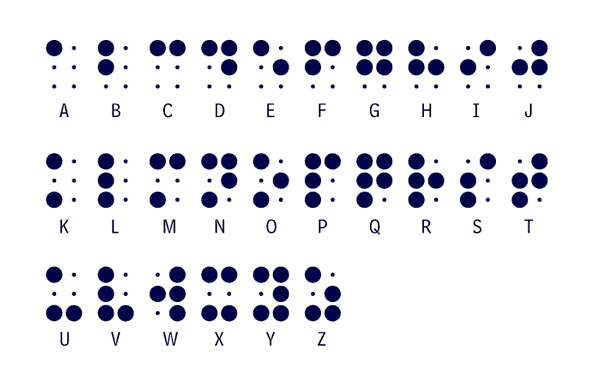
Fun fact: because there is no ‘x’ in the French alphabet, though each row of letters just adds one more don’t to the sequence, the pattern is broken when one reaches ‘x’ as it was added in later!
above articule writen by: S.Hamlet
foot notes:http://www.afb.org/Braillebug/louis_braille_bio.asp
http://en.wikipedia.org/wiki/Louis_Braille
Subscribe to:
Posts (Atom)